
What 98.7% of List Price Means for West Valley Sellers
What 98.7% of List Price Means for West Valley Sellers
TL;DR
- West Valley homes in the June 2026 data sold for about 98.7% of their final list price.
- That does not mean sellers were only 1.3% below where they originally started.
- The video data showed sellers taking roughly a 4% total hit from the original list price when price changes and concessions were considered.
- For sellers, the more important question is not just sale-to-list percentage. It is how many adjustments were required before the market accepted the price.
A statistic like 98.7% of list price sounds reassuring.
A homeowner might hear that and think, “If I list at $500,000, buyers are basically paying asking price.”
That is not necessarily what the number means.
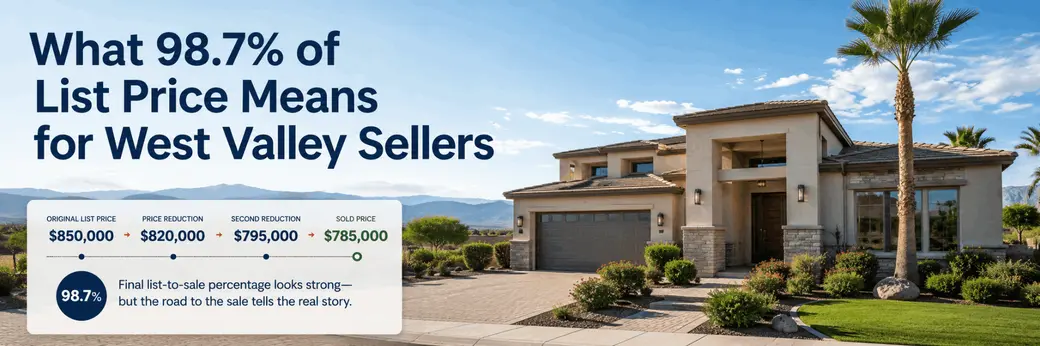
The June 2026 West Valley data discussed in the video showed homes closing at about 98.7% of the list price in place when they sold. At the same time, sellers were taking roughly a 4% hit from their original list price once the full pricing path and concessions were considered.
That difference matters.
See West Valley home updates before anyone else searching Google.
One click tells Google to show Downs RE first for local market news, home values, and West Valley updates. Takes 10 seconds, no account needed.
Add Downs RE as My SourceWatch: Days on Market & List-to-Sale Price
The Question Sellers Should Ask: 98.7% of Which Price?
Imagine a West Valley home starts at $500,000.
If it does not attract the right buyer response, the seller may reduce it to $490,000, then perhaps reposition again before accepting an offer.
If the final contract is close to that later asking price, the sale-to-list statistic can still look strong.
But that does not erase the price reductions that happened before the sale.
That is why the original list price versus final sale price can tell a different story from the final list-to-sale percentage.
A 98.7% statistic is useful. It just needs context.
June 2026: 83.8 Cumulative Days on Market
The same West Valley snapshot showed 83.8 cumulative days on market with approximately four months of housing supply.
The important part is what those figures do not tell us.
Days on market tells us how long a property took to sell. It does not tell us why.
- Was the home overpriced?
- Did it receive plenty of showings but no offers?
- Was the condition noticeably weaker than competing homes?
- Did buyers prefer a nearby new-construction community offering rate incentives?
- Was the property on a busy road, backing commercial space, or competing against homes with better lots?
Those questions matter throughout Goodyear, Buckeye, Litchfield Park, Surprise, Avondale, Waddell and the rest of the West Valley.
An 84-Day Average Does Not Mean Every Home Should Take 84 Days
This is where sellers can misuse market statistics.
An average is not a prescription.
A well-positioned property in Palm Valley may behave differently from a similar-priced home farther south in Goodyear. A newer Buckeye home competing directly against builder inventory may have a different pricing challenge than an established Litchfield Park property near the Wigwam area.
A Waddell home with an RV garage or larger lot may attract a narrower but highly motivated buyer pool.
Even within the same subdivision, backing a greenbelt, having a better lot, updated interiors, solar obligations, traffic exposure, or a three-car garage can change buyer response.
The market average gives you context. Your competition determines your strategy.
The 10-Second Impression Window Still Matters
Pricing is only one part of what happens once a buyer opens the listing.
The first photos, curb appeal, condition, layout and perceived value begin creating an opinion almost immediately. That is what we call the 10-Second Impression Window.
If two Goodyear homes are priced within $10,000 of each other and one appears cleaner, brighter, better maintained and more move-in ready, buyers do not evaluate the price difference in isolation. They evaluate what they receive for the payment.
When buyers consistently choose competing properties, a seller may eventually have to reduce the price enough to overcome that initial disadvantage.
That reduction can disappear inside a later 98.7% sale-to-list statistic.
Concessions Can Create Another Layer
The video also points out that the total seller “haircut” can include concessions.
That can include:
- Closing costs
- Interest-rate buydowns
- HOA-related expenses
- Repairs
- Home warranties
- Other negotiated costs
A seller can technically sell close to the final asking price while still giving meaningful concessions.
That is why the headline sale price alone does not always describe the seller's actual negotiating outcome.
A Better Seller Pricing Diagnostic
1. Original List Price
Where did the property enter the market?
2. Showing Activity
Did qualified buyers actually come through the door?
3. Buyer Reaction
Were buyers interested but hesitant, or were they ignoring the property altogether?
4. Price Reductions
How many adjustments were needed before activity changed?
5. Offer Terms
Was the eventual buyer also asking for closing-cost assistance, a rate buydown or other concessions?
6. Final Net Result
After the full negotiation, how did the seller perform relative to where the property originally started?
Why This Matters More in Some West Valley Submarkets
In Buckeye, sellers may be competing directly against builders advertising financing incentives that a resale homeowner cannot duplicate dollar-for-dollar.
In Goodyear, two homes at similar prices can compete very differently depending on Palm Valley versus Estrella, freeway access, age, lot, condition and neighborhood amenities.
In Litchfield Park, established neighborhoods, larger lots, mature landscaping and custom-home pockets can make broad city averages less useful.
In Waddell, Surprise and outer West Valley areas, buyers may place more value on garages, RV access, lot size and elbow room.
The Bottom Line
The June 2026 West Valley numbers are not saying sellers are simply getting 98.7% of whatever number they originally choose.
They are showing why sellers need to understand the difference between original asking price, final asking price, contract price and concessions.
If you are preparing to sell, the practical step is to look at the homes buyers will compare against yours and establish your pricing position before the market forces you to do it later.
Read More West Valley Real Estate Blogs
- The 10-Second Home Staging Rule | West Valley RE
- What Halts Resale Closings in West Valley? | Downs RE
- Goodyear AZ Market Report June 2026 | Downs RE Legacy Team
- West Valley Housing Market Update: July 2026
- Goodyear Real Estate Market Report | April 2026
FAQ
Does 98.7% of list price mean West Valley sellers only negotiate 1.3%?
No. Tim and Stephanie Downs at the Downs RE Legacy Team note that the June 2026 West Valley figure measures the relationship between the sale price and the list price in place when the property sold; it does not necessarily show how far the property moved from its original asking price or how concessions affected the final outcome.
How long were West Valley homes taking to sell in the June 2026 data?
The June 2026 data used in this analysis showed 83.8 cumulative days on market. The Downs RE Legacy Team recommends treating that as market context rather than a target because a home's price, condition, location, lot, competition and buyer response can cause an individual Goodyear, Buckeye or Litchfield Park property to sell faster or slower.
Why can a seller reduce the price and still show a strong list-to-sale percentage?
Based on the pricing pattern discussed by the Downs RE Legacy Team, a home can begin at one price, undergo one or more reductions and then sell very close to its later asking price. The resulting list-to-sale percentage can therefore look strong even though the seller moved farther from the original list price.
Do seller concessions affect how I should interpret the sale price?
Yes. The Downs RE Legacy Team advises West Valley sellers to evaluate concessions along with the contract price because closing-cost assistance, rate buydowns or other negotiated credits can change the seller's effective result even when the recorded sale price appears close to asking.
Should I use the West Valley average to price my Goodyear or Buckeye home?
The Downs RE Legacy Team uses broad West Valley statistics as context, but Tim and Stephanie Downs recommend pricing from the home's actual competitive set. A Goodyear property in Palm Valley, an Estrella home, a Buckeye resale competing with builders and a larger-lot Waddell property can face very different buyer behavior even during the same market.

Tim Downs
Downs RE Legacy Team
West USA Realty
623-624-8275
Categories
Recent Posts