Buying a 20-Year-Old Home in West Valley Arizona
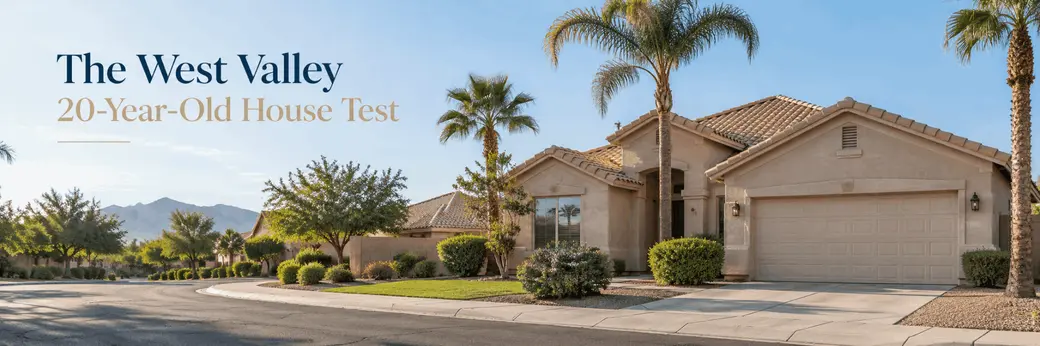
The West Valley 20-Year-Old House Test
TL;DR
- A 20-year-old West Valley home is not automatically a problem. The bigger issue is whether several original systems are reaching replacement territory at the same time.
- Look beyond cosmetics. Fresh paint and remodeled flooring matter less if the roof underlayment, HVAC, water heater and pool equipment all deserve attention.
- Ask for history, not just condition. Replacement dates, invoices, permits, warranties and maintenance records can completely change how you evaluate an older resale.
- Use the inspection period strategically. The goal is not to make the seller replace everything old. It is to understand your financial exposure before deciding what the house is worth to you.
There is a particular generation of homes across Goodyear, Avondale, Litchfield Park, Surprise and other parts of the West Valley that deserves a slightly different kind of home-shopping strategy.
The house may look great.
Granite counters. Updated flooring. Fresh interior paint. A pool. Maybe even a three-car garage.
But if the home was built in the early-to-mid 2000s, another question belongs right beside bedrooms, square footage and price:
How much of the house is still original?
That is the basis of what we call the West Valley 20-Year-Old House Test.
The purpose is not to avoid older homes. Some established West Valley resales offer mature landscaping, finished backyards, pools, larger lots and locations that newer construction cannot easily duplicate.
The purpose is to make sure you understand whether you are buying one aging component or potentially several of them at once.
Find these West Valley real estate updates useful? Add Downs RE as a preferred source in Google.
Add Downs RE as a Preferred SourceWhy 20 Years Changes the Conversation
There is no magical birthday when a house becomes "old."
A well-maintained 20-year-old house can be a better purchase than a poorly maintained 10-year-old house.
But once a property gets into this age range, buyers should stop asking only:
"Does everything work today?"
A better question is:
"What am I likely inheriting?"
An air conditioner can be functioning during the inspection. A tile roof can look perfectly normal from the street. A pool pump can turn on. A water heater can produce hot water.
None of those facts, by themselves, tell you the complete ownership story.
Age, maintenance history, previous repairs and current condition need to be considered together.
1. Start With the Roof, But Look Under the Tile
This is particularly important in established Goodyear communities such as Palm Valley and other neighborhoods developed during the major West Valley growth periods of the early 2000s.
Arizona tile roofs create an easy misconception.
Buyers see concrete or clay tile and think:
"The roof is tile, so it lasts forever."
But the tiles are only one part of the roof system. The material underneath them matters too.
A buyer evaluating an older tile-roof home should ask:
- Is the roof original?
- Has the underlayment ever been replaced?
- Are there invoices or warranty information?
- Have sections been repaired?
- Are there signs of prior leaks?
- What does a qualified roof inspection show?
One home may have a roof that has already received substantial work. The house next door may look nearly identical from the street while still having its original roof components.
Those are not the same purchase.
This is exactly why we previously created the Palm Valley Tile Roof Reality. A home's roof deserves more investigation than simply looking for cracked tiles from the driveway.
2. Find Out Whether the HVAC Is Original
Air conditioning is not a background feature in the West Valley.
In July and August, it becomes essential infrastructure.
So when we are looking at an older Goodyear, Avondale, Surprise or Buckeye resale, HVAC age immediately becomes part of the financial conversation.
Ask:
- How old is each unit?
- Has either unit been replaced?
- Has the system received regular service?
- Are service records available?
- Are there known repairs?
- Are all rooms cooling properly?
- What does the inspection show?
A two-story house can make this even more important because it may have multiple HVAC systems.
If one system has already been replaced and the other is considerably older, that is useful information.
It does not automatically mean you should ask the seller for a new air conditioner. It means you should know what you are buying.
3. Do Not Forget the Water Heater and Plumbing
Water heaters tend to attract much less attention during a showing.
Nobody walks into a beautiful kitchen and says, "I wonder what year the water heater was manufactured."
But once you are seriously considering the property, these quieter systems become more important.
- Water-heater age and condition
- Evidence of corrosion or leakage
- Plumbing repairs
- Shutoff valves
- Water pressure
- Drainage concerns
- Visible supply connections
- Any history the seller provides
The important distinction again is between age and condition.
An older component does not automatically mean it has failed. But several older components together can change the amount of money you want available after closing.
4. A Pool Adds Another Set of Systems
A West Valley pool can be a major lifestyle feature.
It can also turn one inspection into several.
Instead of simply asking whether the pool looks nice, investigate:
- Pump
- Filter
- Heater, if equipped
- Cleaning system
- Visible plumbing
- Electrical components
- Surface condition
- Decking
- Water features
- Signs of leakage or previous repair
A seller may have resurfaced the pool recently while leaving older equipment in place. Another home may have an older surface but brand-new equipment.
The word pool on an MLS listing tells you almost none of that.
The better-looking pool is not automatically the less expensive pool to own.
5. Windows, Seals and Exterior Condition Matter Too
Arizona sunlight and heat are hard on exterior materials.
During the inspection and your own property evaluation, look beyond major mechanical systems.
- Window condition and seals
- Exterior paint
- Stucco cracking
- Weather stripping
- Irrigation
- Garage-door operation
- Exterior doors
- Patio structures
- Drainage around the home
Individually, many of these may be normal maintenance issues.
Together, however, they can tell you something about how consistently the property has been maintained.
A 20-year-old house that has been maintained continuously can present a very different ownership picture from one where maintenance was repeatedly deferred.
The Biggest Question: What Has Already Been Replaced?
This is where the West Valley 20-Year-Old House Test becomes much more useful than simply asking how old the home is.
Imagine two houses built in 2005.
House A
The seller has already:
- Replaced the HVAC
- Replaced the water heater
- Completed substantial roof work
- Updated pool equipment
- Repainted the exterior
House B
Nearly everything is original.
They may have the same year built. They may have similar floor plans. They may even have similar list prices.
But they do not present the same future expense profile.
Ask for documentation when it is available:
- Receipts
- Contractor invoices
- Warranty information
- Permit history where applicable
- Service records
- Seller disclosures
- Insurance-related repair information
The more you can establish about what happened to the property during those 20 years, the less you have to guess.
Cosmetics Can Distract From Expensive Questions
One of the easiest mistakes to make while shopping for a resale home is assigning too much weight to what photographs well.
Buyers naturally notice:
- Flooring
- Cabinets
- Countertops
- Paint
- Fixtures
- Furniture
- Staging
Those things affect how the house feels.
But an attractive remodeled kitchen does not tell you anything about the roof.
New carpet does not make the HVAC newer.
Fresh exterior paint does not tell you the pool pump's age.
This is part of the same problem we discuss in our West Valley Listing History Test: what attracts you to the listing and what ultimately determines whether the property makes financial sense are not always the same things.
Run the Test Before Comparing Resale With New Construction
This is also useful when a buyer is deciding between established resale neighborhoods and newer construction.
Suppose a resale home costs slightly less and already includes:
- Mature landscaping
- Window coverings
- Appliances
- A finished backyard
- A pool
- Garage storage
- An extended patio
That can represent real value.
But now run the 20-Year-Old House Test.
What has been replaced? What still appears original? What may deserve budgeting during the next several years?
Then run the same complete-cost exercise on the new construction.
What will the backyard cost? What about blinds? Appliances? Lot premium? HOA or applicable assessments? Builder financing?
That is why our Builder Incentive Trap and the 20-Year-Old House Test work together.
Do not decide based on "new versus old."
Compare the actual houses and the actual transactions.
The BINSR Friction Zone: Old Is Not the Same as Broken
This may be the most important transaction distinction in the entire article.
An inspection is likely to identify quite a few items in a 20-year-old house.
That does not mean every one of them belongs on a giant repair demand.
There is a major difference between:
This component is older
and
This component has a material defect.
Buyers should understand both, but negotiations need to remain strategic.
During an Arizona resale inspection period, the information can influence decisions involving:
- Seller repairs
- Credits or concessions when permitted
- Price discussions
- Additional specialist inspections
- Acceptance of an item as-is
- Whether the buyer is comfortable proceeding
We call this the BINSR Friction Zone.
The larger the repair request becomes, the more likely the transaction can turn into a second negotiation.
The goal should not be:
"Make this 20-year-old house new."
The better objective is:
"Identify the issues that materially affect whether this purchase still makes sense."
For more on this part of the transaction, read Contract Killers: What Halts Resale Closings in the West Valley Market.
Build a First-Few-Years Ownership Picture
Before the inspection period ends, try to answer a simple question:
If I buy this house, what could realistically demand money from me during my first few years of ownership?
Not everything will fail.
Do not automatically add up the replacement cost of every older component and assume you will spend that entire amount.
Instead, sort the house into three groups:
Already Addressed
Major systems or components that have been replaced or substantially updated.
Working, But Worth Watching
Older components currently functioning but deserving future budgeting.
Current Concerns
Defects or conditions identified during inspections that deserve immediate attention or a transaction decision.
That gives you a much more realistic picture than either extreme:
"This house is 20 years old, so everything is bad."
or
"Everything turned on, so we're fine."
Different West Valley Areas Create Different Comparisons
Goodyear
Established communities such as Palm Valley, Canyon Trails and other early-2000s neighborhoods can put buyers into exactly this analysis.
Location, established landscaping and finished improvements may be difficult to duplicate in brand-new construction. But system history matters.
Avondale
Buyers can encounter established subdivisions where condition varies considerably from one property to the next even when the homes were built within a few years of each other.
Maintenance history becomes part of the comparison.
Litchfield Park
Some buyers prioritize mature neighborhoods, larger lots, custom properties or a location that simply cannot be recreated in a newer subdivision.
An older house may absolutely win that comparison. You just need to understand the house along with the land and location.
Surprise
Surprise has a wide mix of housing ages, giving buyers opportunities to compare established homes with substantially newer inventory.
That makes the future-maintenance discussion especially useful.
Buckeye
Buckeye adds another dimension because newer construction frequently competes directly with resale.
A buyer may be choosing between an older finished property and a newer home carrying builder incentives but requiring additional post-closing improvements.
Run both numbers.
The 20-Year-Old House Test
Roof
- What is original?
- What has been repaired or replaced?
- Are records available?
- Does a specialist inspection make sense?
HVAC
- How old is each system?
- What maintenance or repairs have been completed?
- Are there multiple units?
Water and Plumbing
- What is the water-heater age?
- Are there visible leaks, corrosion or previous repairs?
- What does the inspection show?
Pool
- What is the equipment age?
- What has been replaced?
- What is the condition of the surface and decking?
Exterior
- What is the condition of paint, stucco, windows, seals, doors and irrigation?
Records
- Are invoices, warranties, permits or service records available?
Transaction
- Which issues are actual current defects?
- Which are simply older components to budget for?
- Which concerns materially change what you are willing to pay for the house?
If you can answer those questions, the year built becomes far less intimidating.
You are no longer buying "a 20-year-old house."
You are buying a specific property with a specific maintenance history.
The Bottom Line
Do not reject a West Valley home just because it was built 20 years ago.
And do not assume a beautifully remodeled resale has already taken care of everything that matters.
Look underneath the cosmetics.
Find out what is original. Find out what has been replaced. Inspect the expensive systems. Look for documentation.
Then decide whether the combination of price, condition, location, improvements and future ownership costs makes sense.
That is the West Valley 20-Year-Old House Test.
If you're comparing older resale homes in Goodyear, Buckeye, Litchfield Park, Avondale, Surprise or elsewhere in the West Valley, text, email or call us. We can help you look beyond the listing photos and evaluate the complete property.
Read More West Valley Real Estate Blogs
- What Listing Photos Don’t Tell West Valley Buyers
- Contract Killers: What Halts Resale Closings in the West Valley Market
- The West Valley Builder Incentive Trap
- The West Valley Solar Transfer Trap
- Palm Valley Tile Roof Reality | Goodyear AZ
FAQ
Is a 20-year-old home too old to buy in Goodyear or the West Valley?
No. Tim and Stephanie Downs at the Downs RE Legacy Team recommend judging a West Valley resale by its current condition, maintenance history and major-system updates rather than the construction year alone. A 20-year-old Goodyear home with documented HVAC, roof and pool improvements may present a very different ownership picture from a similar-age property where nearly everything remains original.
What should I inspect most carefully in a 20-year-old Arizona home?
The Downs RE Legacy Team recommends paying particular attention to the roof system, HVAC equipment, water heater and plumbing, pool equipment when applicable, windows and seals, exterior condition and evidence of deferred maintenance. Those areas can be especially important when several components in a Goodyear, Avondale, Litchfield Park or Surprise home are similar in age.
Should I ask a seller to replace an old HVAC or roof if it still works?
Not automatically. In West Valley transactions, the Downs RE Legacy Team distinguishes between an older component and an actual defect identified during due diligence. Age can affect the buyer's budgeting and offer strategy, but the appropriate BINSR request depends on condition, inspection findings, contract circumstances and the overall negotiation.
Are older West Valley resale homes a worse value than new construction?
Not necessarily. The Downs RE Legacy Team sees established resale homes offering features such as finished landscaping, pools, window coverings, mature trees and existing improvements that may cost substantial money to add to a new build. Tim and Stephanie Downs recommend comparing those benefits with the resale home's major-system condition and comparing the complete resale transaction against the complete new-construction transaction.
What records should I ask about when buying an older West Valley home?
The Downs RE Legacy Team recommends looking for available contractor invoices, HVAC service records, roof documentation, pool-equipment records, warranties, applicable permit information and seller disclosures. Documentation can help buyers in Goodyear, Buckeye, Litchfield Park and surrounding communities distinguish between a home that has simply aged and one that has been actively maintained and updated.

Tim and Stephanie Downs
Downs RE Legacy Team
West USA Realty
623-624-8275
Categories
Recent Posts