
The Palm Valley Tile Roof Reality
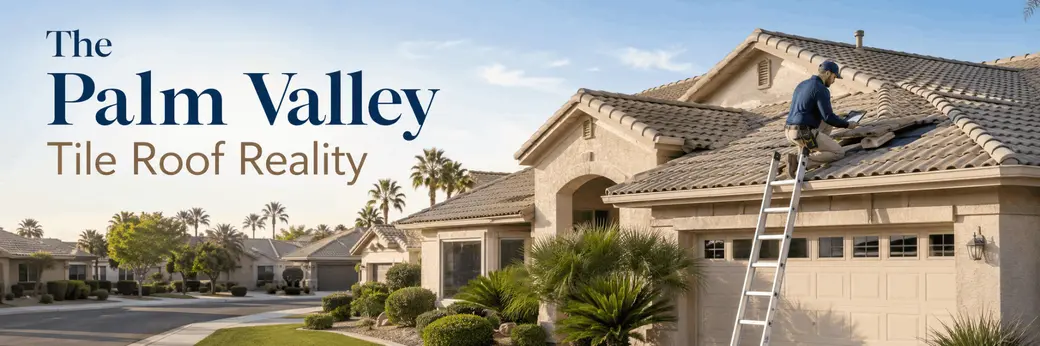
The Palm Valley Tile Roof Reality
TL;DR
- A clean-looking tile surface does not reveal the condition of the underlayment, flashing, valleys, or roof deck below it.
- Palm Valley buyers should investigate the scope and date of past roof work—not settle for “the roof was repaired.”
- Roof concerns should be evaluated and priced before the Arizona inspection period expires so the BINSR can be specific.
- Sellers can reduce negotiation problems by gathering roof invoices, warranties, leak records, and solar documents before listing.
Drive through Palm Valley and you will see one of north Goodyear’s most recognizable streetscapes: stucco homes, concrete tile roofs, mature palm trees, greenbelts, golf-course sections, and established neighborhoods near Litchfield Road and McDowell Road.
From the street, many of those roofs still look solid.
That appearance is useful, but it does not tell the whole story.
The visible tile is only one part of a roof system. Buyers also need to understand the underlayment beneath the tile, the flashing around penetrations, the condition of valleys, the history of leak repairs, and whether solar panels were added after the original roof installation.
This does not mean every established Palm Valley home has a roof problem. It means buyers should not judge the roof by tile color and curb appeal alone.
See West Valley home updates before anyone else searching Google.
One click tells Google to show Downs RE first for local market news, home values, and West Valley updates. Takes 10 seconds, no account needed.
Add Downs RE as My SourceA Tile Roof Is More Than the Tile
Concrete tile is designed to shed most rainwater and protect the roof system from direct exposure. But water can still move beneath individual tiles during heavy rain, wind-driven weather, or when tiles are cracked, displaced, or improperly installed.
Several components work together:
- Concrete or clay roof tiles
- Underlayment installed over the roof deck
- Flashing around vents, skylights, walls, valleys, and other penetrations
- Battens or fastening systems
- The wood roof deck beneath the roofing materials
- Sealants and transition materials at vulnerable areas
A roof can therefore have tiles that look acceptable while the materials below them need attention.
That is why “the tiles are good” is not the same as “the roof has been fully evaluated.”
Why This Matters in Palm Valley
Palm Valley includes established subdivisions with mature landscaping, golf-course homes, repeated builder floor plans, and tile-roof architecture that gives the area a consistent appearance.
But similar-looking homes can have very different roof histories.
One homeowner may have completed a full tile lift-and-relay with new underlayment. Another may have repaired a single valley. A third may have replaced broken tiles without addressing the underlying material. A fourth may have installed solar panels several years after the home was built.
All four roofs may look similar from the sidewalk.
Their likely maintenance needs may be very different.
Mature Landscaping Changes the Inspection Conversation
Palm Valley’s mature trees and landscaping are part of the neighborhood’s appeal, but leaves, seed pods, and other debris can collect in valleys or around roof transitions.
The concern is not simply whether debris is visible. Buyers should look for signs that drainage paths have been obstructed or that water has repeatedly concentrated in one area.
Homes in older portions of Litchfield Park may present similar questions, especially when mature trees, additions, patio roofs, custom construction, or more complicated rooflines are involved.
Solar Panels Add Another Layer
Solar does not automatically mean the roof was installed incorrectly. It does mean buyers should ask additional questions.
Solar mounting systems create penetrations or modifications within the roof system. Proper flashing at both the tile and underlayment level is important when those penetrations are made.
Buyers should determine:
- When the solar system was installed
- Whether the roof was evaluated before installation
- Whether any roof work has been completed since installation
- Who installed the solar mounting system
- Whether roof-access or panel-removal costs could apply to future work
- Whether warranties or installation documents are available
A roof inspection that ignores the solar installation history is incomplete.
Five Roof Assumptions That Can Cost Buyers Money
1. “The Tiles Look Fine”
Tiles may be intact while underlayment, flashing, sealants, or roof transitions need attention.
The exterior appearance is a starting point, not a final conclusion.
2. “The Seller Said the Roof Was Repaired”
The word “repaired” can describe very different work.
It could mean:
- One broken tile was replaced
- A small leak was sealed
- A valley was rebuilt
- Damaged decking was replaced
- A section received new underlayment
- The entire tile field was lifted and new underlayment was installed
Buyers should ask for invoices showing the location, scope, date, contractor, and materials used.
3. “There Are No Ceiling Stains, So It Has Never Leaked”
Ceiling stains may have been painted. A prior leak may have been repaired correctly. A leak may also be intermittent and only appear during certain wind or rain conditions.
Interior ceilings should be reviewed alongside attic observations, exterior roof conditions, repair records, and the seller’s disclosures.
4. “A Home Inspection Covers Everything”
A general home inspection is an important first step, but roof access and inspection scope can vary.
A general inspector may identify cracked or displaced tiles, staining, visible deterioration, damaged flashing, or evidence of moisture. When the roof history is unclear or the report raises concerns, a qualified roofing contractor may be needed to determine the extent of the problem and provide a realistic estimate.
5. “Insurance Can Wait Until the End”
Buyers should begin obtaining homeowners insurance information early in the transaction.
Different insurers may ask different questions about roof age, prior claims, condition, or completed work. Waiting until the final days before closing can leave little time to correct inaccurate information or find another policy.
The Palm Valley Roof Documentation Test
A roof should not be described only as “original,” “newer,” or “repaired.”
Those words are too vague to support a major financial decision.
Buyers should ask for specific documentation.
Questions to Ask About the Roof
- When was the original roof system installed?
- Has the underlayment ever been replaced?
- Was the work completed across the entire roof or only one section?
- Have there been any leaks, stains, or insurance claims?
- Which contractor completed the work?
- Are invoices, photographs, permits, warranties, or receipts available?
- Were solar panels installed before or after the most recent roof work?
- Will any roof or workmanship warranty transfer to the buyer?
- Have tiles been replaced with the same profile and color?
- Has a roofing contractor evaluated the roof recently?
The seller may not have every answer, especially if the work was completed by a previous owner. Missing paperwork does not prove that the roof is defective.
It does increase uncertainty.
That uncertainty often becomes negotiation pressure during the inspection period.
Entering the BINSR Friction Zone
The roof can become one of the most important items on an Arizona Buyer’s Inspection Notice and Seller’s Response.
The problem is that vague requests produce vague negotiations.
“Repair the roof as needed” does not clearly identify:
- The defect
- The location
- The expected correction
- The required contractor
- The documentation the buyer expects afterward
A stronger request connects the inspection finding to a defined solution.
For example, the request might identify a specific active leak, damaged flashing, displaced tiles, deteriorated underlayment in an evaluated area, or moisture-damaged decking. It can then state what correction is requested and what paid receipt or contractor documentation should be provided.
Repair, Credit, Price Adjustment, or Cancellation?
There is no single correct roof negotiation for every Palm Valley home.
The right approach depends on:
- Whether the problem is localized or widespread
- Whether active moisture intrusion is present
- The estimated cost
- The home’s contract price
- Competing offers
- The seller’s financial ability to complete the work
- The buyer’s available cash after closing
- Lender restrictions on concessions or credits
- Insurance requirements
- The time remaining before closing
A minor repair may be better handled by the seller before closing.
A larger project may lead to a negotiated concession, price adjustment, or different transaction decision. Any concession must fit the purchase contract and lender requirements.
The goal is not to turn every cracked tile into a major dispute. The goal is to determine whether the finding is routine maintenance, a localized defect, or evidence of a larger roof-system issue.
How Palm Valley Sellers Can Prepare
A seller does not need to replace a functioning roof simply because the home is in an established neighborhood.
But sellers should prepare for roof questions before the buyer’s inspector arrives.
Gather the Paperwork
Collect:
- Roofing invoices
- Warranty documents
- Insurance claim records
- Leak-repair receipts
- Underlayment replacement records
- Contractor photographs
- Solar installation documents
- Panel-removal or reinstallation agreements
- Records from work completed by a previous owner
Documentation can prevent a buyer from assuming that a $1,500 repair was a $25,000 project—or that a broad roof project was only a cosmetic patch.
Describe the Work Accurately
Avoid calling the roof “new” unless the description is accurate and supported.
There is a meaningful difference between:
- Replacing several tiles
- Repairing one valley
- Replacing underlayment in one section
- Completing a full tile lift-and-relay
- Installing an entirely different roof system
Specific language builds more confidence than broad claims.
Consider a Pre-Listing Evaluation
A pre-listing roof evaluation may make sense when:
- The roof history is unknown
- There are visible displaced or broken tiles
- An old ceiling stain is present
- The home has experienced prior leaks
- Solar panels cover a significant portion of the roof
- The seller expects the buyer to raise the issue
- The home previously fell out of contract over inspection concerns
The purpose is not to manufacture a perfect report. It is to understand the issue before the seller is facing a contractual deadline.
Fix Active Problems
Active leaks, loose tiles, damaged flashing, rotted wood, or visibly incomplete prior work should not be ignored simply because the listing photographs look good.
The 10-Second Impression Window may help get buyers through the front door.
Roof documentation helps keep them comfortable after the inspection.
Palm Valley, Litchfield Park, and Avondale Are Not Identical
A buyer searching within a few miles of Litchfield Road may encounter very different roof situations.
Palm Valley
Palm Valley buyers frequently compare established builder homes with similar stucco-and-tile architecture. Roof history, solar installation, golf-course exposure, landscaping, and prior maintenance can help separate two otherwise similar homes.
Litchfield Park
Litchfield Park includes custom homes, mature citrus-area properties, additions, larger lots, and homes with more complicated rooflines. A one-size-fits-all inspection strategy is less useful when the construction varies from property to property.
Avondale
Avondale includes a wide range of ages, floor plans, and price points. For buyers using a significant portion of their available savings for the purchase, an unexpected roof project can have a larger effect on the post-closing budget.
The distance between two homes may be small. The roof history and transaction risk may not be.
Key Insights
- Tile appearance does not establish underlayment condition.
- Roof repairs should be verified by scope, date, and documentation.
- Solar installation history belongs in the roof review.
- Buyers should obtain roofing and insurance information before contractual deadlines.
- BINSR requests should identify specific defects and realistic corrections.
- Sellers benefit from reducing uncertainty before the property is listed.
- Two similar Palm Valley homes can carry very different future maintenance obligations.
The Bottom Line
Do not reject a Palm Valley home simply because the roof is older, and do not approve it simply because the tiles look clean.
Investigate the entire roof system.
For buyers, that means reviewing the general inspection, obtaining a roofing evaluation when warranted, checking insurance early, and getting written estimates before completing the BINSR.
For sellers, it means gathering records, describing prior work accurately, and dealing with active problems before a buyer is working against an inspection deadline.
The practical next step is simple: before making an offer or listing an established tile-roof home in Palm Valley, organize the roof history and identify what is known, what is documented, and what still needs to be evaluated.
Read More West Valley Real Estate Blogs
- The Arizona BINSR: Navigating the Friction Zone in Goodyear & Buckeye
- Contract Killers: What Halts Resale Closings in the West Valley Market
- The Hidden Costs of Buying a Home in Arizona (What Most Buyers Don’t Expect)
- The 10-Second Impression Window: Staging West Valley Homes to Sell
- Goodyear AZ Market Report June 2026 | Downs RE Legacy Team
FAQ Section
Do Palm Valley tile roofs need replacement when the tiles still look good?
No. A tile roof can look clean from the street while still needing closer review of the underlayment, flashing, valleys, and prior repairs. The right question is not simply how the tiles look. It is what work has been completed beneath them, when it was done, and whether there is documentation.
Can a general home inspector evaluate the roof underlayment?
A general home inspector can identify visible roof concerns and signs of possible moisture intrusion, but access and scope can be limited. When the roof history is unclear or the report raises concerns, a separate evaluation by a qualified roofing contractor can help define the condition and likely scope of work.
Should a buyer request a complete roof replacement on the BINSR?
Not automatically. The request should match the evidence. A localized defect may call for a specific repair, while broader underlayment failure may justify a larger correction, credit, or a decision not to proceed. The strongest BINSR position is based on a clear inspection finding and a realistic quote.
Does solar change how a Palm Valley roof should be inspected?
Yes. Solar attachments create roof penetrations and can limit access to areas beneath the panels. Buyers should review the solar documents, installation history, roof work completed before or after the panels were installed, and whether a roofer may need to coordinate with the solar company.
What should Palm Valley sellers do about the roof before listing?
Gather roof invoices, warranties, leak-repair records, and solar installation documents before listing. If the history is unclear or there are visible concerns, consider a roof evaluation before the buyer’s inspection period. Clear documentation reduces uncertainty and helps prevent buyers from assuming the most expensive outcome.

Tim Downs
Downs RE Legacy Team
West USA Realty
623-624-8275
downsre.com