
What Listing Photos Don’t Tell West Valley Buyers
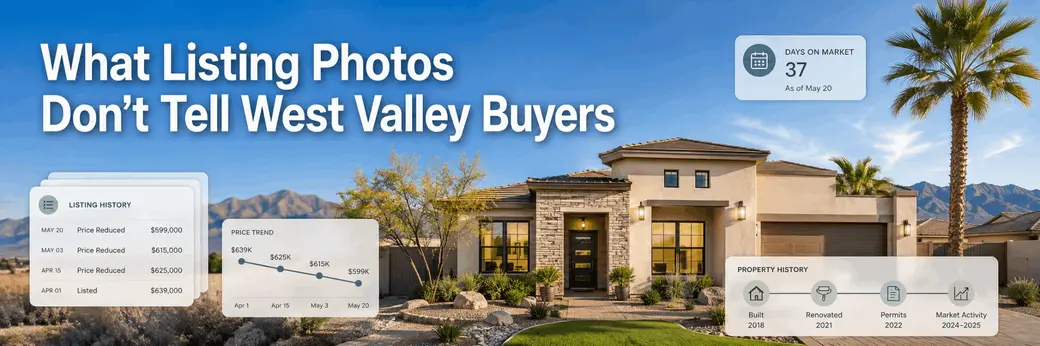
What Listing Photos Don’t Tell West Valley Buyers
TL;DR
- A beautiful listing can still have a complicated history. Price reductions, cancellations, relistings and previous failed contracts can all change how you evaluate the seller’s position.
- The days-on-market number deserves context. In ARMLS, cumulative and agent days on market can tell different stories, and DOM can eventually reset after a property has been off market long enough.
- The property itself needs investigation beyond the photos. Lot position, taxes, solar, HOA rules, previous pricing and nearby competition can matter as much as upgraded kitchens and flooring.
- Before writing an offer, understand what you are actually negotiating against. A little research can help determine whether the home is newly tested by the market, repeatedly rejected at a higher price, or simply being repositioned.
Listing photos are designed to help you decide whether you want to see a house. They are not designed to tell you the whole story of the property.
A West Valley home can photograph beautifully, check the right boxes and still leave important questions unanswered.
How many times has it been listed? Has the price been reduced? Was it under contract before? Was it canceled and put back on the market? Does the current days-on-market number represent the home's entire recent exposure? How does its property tax bill compare with nearby homes? Is there solar, and if so, what exactly comes with it? Is the backyard actually usable for what you want to do?
Those questions are part of what we call the West Valley Listing History Test.
The goal is not to find something wrong with every home. It is to understand the property well enough that the offer you write reflects more than what you saw during a 30-minute showing.
Find these West Valley real estate updates useful? Add Downs RE as a preferred source in Google.
Add Downs RE as a Preferred SourceThe Listing History Test Starts Before the Showing
Most buyers naturally begin with the obvious filters:
- Price
- Bedrooms
- Bathrooms
- Square footage
- Pool
- Garage
- Lot size
- Photos
- Location
Those are useful.
But once a property becomes a serious contender, we want to go one level deeper.
Imagine two similar four-bedroom homes in Goodyear. Both are listed at $525,000. Both appear to have been on the market for 18 days.
One came on the market at $525,000 and has never changed price.
The other may have previously been offered at a higher price, left the market, returned with different positioning or experienced earlier contract activity.
Those are different negotiating situations even if today's listing page makes them initially look similar.
That is why we do not want buyers making offer decisions from the current list price alone.
1. Look at the Entire Listing History
One of the first things worth reviewing is the property's prior MLS activity.
In Arizona's ARMLS system, an agent can review historical listing records and changes associated with a property.
That can reveal a sequence such as:
- Original listing
- Price changes
- Pending or under-contract periods
- Cancellations
- Expirations
- Relistings
- Previous MLS numbers
- Changes in listing representation
None of those automatically means there is a problem.
A listing can be canceled because a seller changed plans. A contract can fall apart because a buyer's financing failed. A home can be relisted because the seller temporarily took it off the market.
The history is not a verdict. It is a reason to ask better questions.
The question is not just: “How long has it been listed?”
The better question is:
What has happened to this property since the seller first tried to sell it?
That can provide much more context than a single number on the screen.
2. Know the Difference Between DOM and CDOM
Days on market can look deceptively simple.
It is not always simple.
ARMLS tracks both Agent Days on Market (ADOM) and Cumulative Days on Market (CDOM).
CDOM is intended to reflect how long the property has been exposed through the MLS, while ADOM relates to the period associated with an individual listing agent.
A canceled or expired property that remains off the market for a full 45 days can eventually receive a fresh DOM calculation when it is relisted on or after the 46th day.
That means a buyer should be careful about interpreting a low DOM number as: “This house just hit the market.”
Maybe it did.
Maybe the property has a longer story.
Why that matters to an offer
Suppose a Buckeye home appears to have only been active for a week.
If the broader history shows the seller has already tested substantially higher pricing, made several reductions and spent months trying to find a buyer, that information may affect how you think about:
- Seller motivation
- Offer price
- Closing-cost concessions
- Repair negotiations
- Possession timing
- The strength of competing offers
It does not guarantee the seller will negotiate.
It gives you better context for deciding how aggressively you want to try.
3. Follow the Price Changes
Price reductions are another clue that deserves interpretation rather than a simple thumbs-up or thumbs-down.
One reduction does not automatically mean desperation. The seller may simply have corrected an ambitious initial price.
Multiple reductions can tell a different story.
For example:
- $575,000
- $559,000
- $549,000
- $535,000
Now the question becomes:
Where has the market actually been rejecting this property?
If similar homes nearby are selling around $525,000, the seller may finally be approaching the range buyers were expecting.
That is different from a home entering the market at $535,000 for the first time.
Watch the timing, not just the amount
A series of reductions made quickly can indicate a seller who is actively responding to the market.
A tiny reduction after months of limited activity may indicate a seller who is still reluctant to make a meaningful adjustment.
The pattern matters.
This is especially useful when comparing homes in areas where buyers may have several alternatives, including resale homes competing against builder inventory in parts of Buckeye, Goodyear and Surprise.
4. Find Out Whether the Home Was Previously Under Contract
A previous contract is one of the most useful pieces of property history to investigate.
It also requires restraint.
A failed contract does not automatically mean the inspection found something terrible.
Deals fall apart for many reasons:
- Buyer financing
- Buyer changed their mind
- Inspection negotiations
- Appraisal
- HOA concerns
- Solar complications
- Contingencies
- Timing
- Sale of another property
- Personal circumstances
The useful question is not: “What is wrong with this house?”
It is: “What can we legitimately learn about what happened?”
Sometimes the answer may be limited.
But if a property repeatedly goes under contract and returns to the market, that pattern deserves attention before the next buyer writes an offer.
It may influence what inspections deserve extra attention or what questions should be asked during due diligence.
5. Compare the Lot, Not Just the Lot Size
Two West Valley homes can show almost identical lot square footage and function completely differently.
This matters particularly for buyers looking for:
- RV parking
- An RV garage
- A future casita
- A workshop
- Pool space
- Extra vehicle parking
- No neighbor directly behind
- A greenbelt or wash
- More privacy
A 10,000-square-foot lot in Goodyear with a usable side yard may serve an RV owner better than a larger parcel with poor access.
A Buckeye property may look enormous in aerial photos but have drainage, easement, septic, utility or access considerations that reduce what can actually be done with the land.
A Litchfield Park property may have mature landscaping, irrigation infrastructure or existing improvements occupying areas that initially appear open.
That is why lot size is a data point.
Usable lot is the real question.
6. Check the Taxes on the Actual Property
Buyers sometimes look at the estimated monthly payment on a real estate portal and assume the expense calculation applies neatly to the property.
Instead, look at the actual tax information and compare it.
Especially when comparing homes across Goodyear, Buckeye and Litchfield Park, two similarly priced homes can have different tax obligations based on the specific property and taxing districts involved.
New construction deserves additional attention because the tax history shown for a newly built property may not always represent what the property will look like once the completed home is fully reflected in future assessments.
The point is not to predict the buyer's exact future tax bill from one MLS screen.
It is to identify situations where the current displayed information deserves more investigation before the buyer builds a budget around it.
7. Investigate Solar Before You Fall in Love With the Electric Bill
Solar can be one of the biggest examples of a listing feature that requires a second layer of research.
A listing may simply say: Solar.
That is nowhere near enough information.
You want to know whether the system is:
- Owned
- Financed
- Leased
- Subject to a power purchase agreement
- Being paid off at closing
- Expected to transfer to the buyer
If there is an agreement, the terms matter.
A low electric bill in the listing description does not tell you the total financial obligation associated with the system.
For a serious contender, solar documentation should become part of the investigation rather than something discovered halfway through the transaction.
8. Look at the HOA Through the Buyer’s Actual Plans
An HOA is another area where “yes” or “no” tells us very little.
The useful question is:
Will this HOA interfere with the way you intend to use this property?
A buyer who simply wants a standard two-car household may care about very different rules than someone who owns:
- An RV
- A work truck
- A boat
- A trailer
- Multiple vehicles
The same applies to buyers thinking about:
- Short-term or long-term rentals
- A detached structure
- Exterior modifications
- Solar
- A home-based use
- Parking arrangements
In communities throughout Goodyear, Buckeye, Litchfield Park and Surprise, the HOA structure and rules can vary considerably from one neighborhood to another.
Do not assume that something is permitted simply because a neighboring community allows it.
9. Compare the House With What the Buyer Could Purchase Instead
This is one of the most important parts of the Listing History Test.
A property's negotiation position does not exist in isolation.
Look at the alternatives.
If a buyer is considering a $500,000 home in Goodyear, what else can approximately $500,000 buy nearby?
What happens if the buyer moves a few miles?
What does $500,000 buy in Buckeye?
What about a resale versus a new build?
Could the buyer get a larger lot? A pool? A newer HVAC system? A three-car garage? A better lot position? An owned solar system instead of financed solar?
This is where a home's history and its competition come together.
A seller may believe a property is worth the asking price.
But the buyer is deciding whether it is worth choosing over every available alternative.
That is the comparison that ultimately matters.
10. Separate Cosmetic Appeal From Expensive Questions
Listing photos are extremely good at showing:
- New flooring
- White cabinets
- Fresh paint
- Staging
- Lighting
- Countertops
- Backyard furniture
They are much less useful for showing:
- HVAC age
- Roof history
- Solar obligations
- Pool equipment age
- Previous listing failures
- Drainage
- HOA restrictions
- Tax differences
- Easements
- Market competition
That does not mean cosmetic improvements have no value. They absolutely can.
But a buyer should avoid giving a $20,000 emotional premium to finishes while ignoring a much more expensive issue that was never visible in the photos.
The West Valley Listing History Test
When a property moves from “interesting” to “we might actually buy this,” these are the questions worth answering.
Listing History
- How many recent MLS listings are associated with the property?
- Has it been canceled or expired?
- Has it previously been under contract?
- Does the current DOM tell the full recent story?
Pricing
- What was the original asking price?
- How many reductions have occurred?
- How large were they?
- How does the current price compare with recent comparable sales?
Property
- What does the lot actually allow the buyer to do?
- Are there location issues that will affect daily life or resale?
- Are there solar obligations?
- Are the property taxes materially different from competing homes?
- Are there major systems or features that deserve investigation?
Competition
- What other homes can the buyer purchase for similar money?
- Is new construction competing with this resale?
- Does another neighborhood provide a better combination of price, lot, location and condition?
Negotiation
- What does the seller's history suggest?
- Where has the market previously rejected the property?
- Which terms besides price might matter?
- What information still needs to be investigated before committing?
The goal is not to uncover enough negative information to talk yourself out of the house.
The goal is to know what you are buying.
The Bottom Line
Photos tell you whether you want to walk through the front door.
They do not tell you everything you need to know before signing a contract.
When a West Valley property becomes a serious contender, look behind the listing.
Review the history. Follow the price changes. Understand the DOM. Check the taxes. Investigate the solar. Evaluate the lot. Compare the alternatives.
Then decide what the property is worth to you and what kind of offer makes sense.
If you are considering a home in Goodyear, Buckeye, Litchfield Park, Waddell, Surprise or elsewhere in the West Valley, send the property to us. We can help you look beyond the photos and identify the questions worth answering before you commit.
Read More West Valley Real Estate Blogs
- Contract Killers: What Halts Resale Closings in the West Valley Market
- The Arizona BINSR: Navigating the Friction Zone in Goodyear & Buckeye
- The West Valley Solar Transfer Trap
- The West Valley Usable Lot Test
- Buying Near Luke AFB: The Noise & Resale Test
FAQ
Can a West Valley home have more market history than its current days-on-market number suggests?
Yes. ARMLS tracks listing history as well as Agent Days on Market and Cumulative Days on Market, and a property's current listing can require more context than one DOM number provides. The Downs RE Legacy Team recommends reviewing prior MLS activity, price changes, cancellations and previous listings when a Goodyear, Buckeye or Litchfield Park home becomes a serious contender.
Does a canceled or relisted Arizona home mean something is wrong with it?
No. A listing can be canceled or relisted for many reasons, including a change in seller plans, listing strategy or a previous transaction that did not close. Tim and Stephanie Downs at the Downs RE Legacy Team treat a relisting as a reason to investigate the history and ask better questions, not as automatic evidence that the West Valley property has a defect.
Should buyers care if a home has had several price reductions?
Yes, because the pattern can help show how the market has responded to the seller's previous pricing. The Downs RE Legacy Team recommends comparing each reduction with recent comparable sales and current competition in the specific West Valley sub-market rather than assuming that every price reduction automatically means the seller is desperate.
What should I investigate before offering on a West Valley home with solar?
Buyers should determine whether the solar system is owned, financed, leased or subject to another agreement and identify what obligations are expected to remain after the sale. In West Valley transactions, the Downs RE Legacy Team recommends investigating the solar arrangement early so the buyer can evaluate the home and the associated solar obligation together instead of relying only on an advertised electric bill.
What can an agent check that I may not notice in listing photos?
An agent can help investigate prior MLS activity, price changes, comparable sales, lot configuration, property taxes, solar information and location factors that may affect the purchase or eventual resale. For buyers in Goodyear, Buckeye, Litchfield Park and surrounding communities, the Downs RE Legacy Team uses that property-specific review to help separate attractive marketing from the questions that deserve attention before an offer.

Tim and Stephanie Downs
Downs RE Legacy Team
West USA Realty
623-624-8275
Categories
Recent Posts