
Buying Near Luke AFB: The Noise & Resale Test
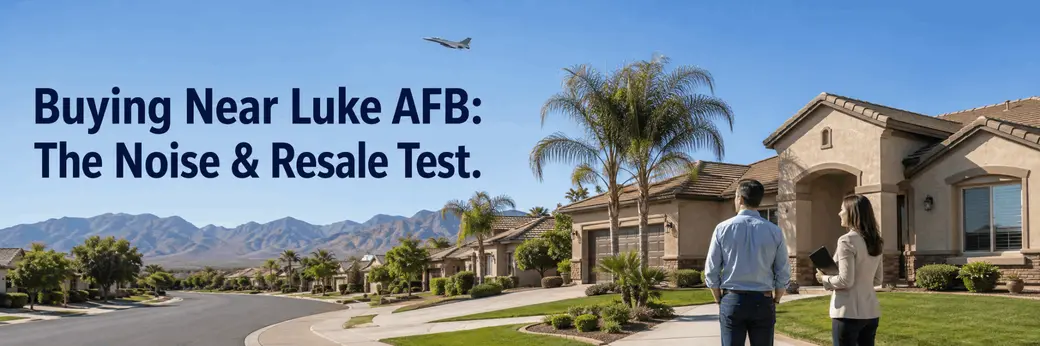
Buying Near Luke AFB: The Noise & Resale Test
TL;DR
- Being inside the Luke AFB disclosure area does not automatically mean a home is inside one of the highest aircraft-noise contours.
- Aircraft noise follows flight activity and flight paths, not city boundaries, so two West Valley neighborhoods a few miles apart can feel very different.
- Before making an offer, visit the property at different times, spend time in the backyard, and compare how it sounds with the doors and windows open and closed.
- Luke proximity can be a commute advantage for one buyer and a resale objection for another, so test both sides before buying.
If you are buying in Litchfield Park, Waddell, Goodyear, Glendale or Surprise, there is a question that a listing description probably will not answer:
What is it actually like to live this close to Luke Air Force Base?
A map can tell you how many miles a house is from the base. That is useful.
But it does not tell you what the backyard sounds like on a weekday afternoon, whether you notice aircraft inside the primary bedroom, or how a future buyer will react when a fighter jet passes overhead during a showing.
That requires a different test.
We call it the Luke AFB Noise & Resale Test.
The goal is not to label a neighborhood as good or bad because it is near Luke. The goal is to understand the location before you own it.
See West Valley home updates before anyone else searching Google.
One click tells Google to show Downs RE first for local market news, home values, and West Valley updates. Takes 10 seconds, no account needed.
Add Downs RE as My Source"Near Luke" Can Mean Two Very Different Things
Arizona has a legally defined "territory in the vicinity" of Luke Air Force Base. For Luke, state law defines that territory as extending 10 miles north, south and west and four miles east of the center of the main runway. Arizona also separately defines high-noise and accident-potential areas.
A seller of residential property within the statutory military-airport vicinity must provide written disclosure to the purchaser before title transfers.
That distinction matters.
A property can be inside the broader disclosure territory without being inside Luke's 65 DNL or higher aircraft-noise contours.
Luke's noise map shows separate contours around the runways, generally following the arrival and departure corridor rather than forming a simple circle around the base.
So when somebody says, "That house is in the Luke disclosure area," the next question should be:
"Okay. But where exactly is the house relative to the flight and noise contours?"
Those are not the same question.
Buyers can review the Arizona Department of Real Estate airport boundary map resources and the applicable Arizona military-airport statutes when evaluating a specific property.
Noise Does Not Follow City Boundaries
This is where generic real estate advice becomes almost useless.
Luke does not suddenly become audible when you cross into Litchfield Park and quiet when you cross into Goodyear.
Luke Air Force Base explains that aircraft noise can vary based on flight activity, weather, seasonal wind patterns and the direction of takeoffs and landings. Published noise contours use Day-Night Average Sound Level, or DNL, based on an average annual day of operations.
That means buyers should think at the address level, not the city level.
Litchfield Park
Litchfield Park deserves particular attention because buyers may be comparing established neighborhoods, larger lots and mature areas only a relatively short drive from Luke.
But "Litchfield Park" is still too broad a description.
One property may feel completely different from another depending on its relationship to the runway corridor, surrounding development, lot orientation and construction.
A larger backyard with mature trees might be one of the reasons you love a house. That also means you may spend considerably more time outside.
That makes the sound experience worth testing before you buy.
Waddell
Waddell buyers frequently care about elbow room.
They may be looking for an acre, an RV garage, horse privileges, a workshop or simply more separation between neighbors.
Those properties require another question:
How much will I actually use the outdoor space?
If the entire reason you are paying an Elbow Room Premium is to sit outside, work in a detached shop, maintain animals or enjoy a large backyard, the outside sound environment matters more than it might for someone buying a different type of home.
Goodyear
Goodyear covers enough territory that saying a home is "near Luke" does not tell us much.
This is where address-specific review matters.
A Goodyear buyer may be balancing proximity to Luke against access to I-10, Loop 303, employment, shopping, Palm Valley, Litchfield Road or other daily destinations.
That can make Luke proximity an advantage rather than simply a concern.
Glendale and Surprise
The same principle applies in Glendale and Surprise.
There can be a big difference between being geographically close to the base, being inside the broader statutory disclosure territory and being positioned relative to an active aircraft corridor.
Do not make the decision from a city name or ZIP code.
Make it from the property.
Run the Luke AFB Noise & Resale Test
1. Run the Address Map Test
Start with the actual property address.
The Arizona Department of Real Estate maintains airport boundary-map resources, and Luke publishes information about its noise contours.
We want to distinguish among:
- General proximity to Luke
- The statutory military-airport vicinity
- Published aircraft-noise contours
- Accident-potential areas
- The home's specific relationship to the runway corridor
Do this before relying on somebody simply saying, "It's close to the base."
2. Run the Backyard Test
This one requires no spreadsheet.
Stand outside.
Not for 30 seconds. Give it some time.
If the house has a pool, covered patio, acre lot, workshop, sport court or outdoor entertaining space, spend time where you would actually live.
Do not have everybody talking the entire time. Listen.
The question is not whether you hear an airplane.
The question is:
Would this change how I use this property?
For some buyers, the answer will genuinely be no. For others, it will matter a lot.
Both answers are useful before you own the house.
3. Run the Inside-the-House Test
Go inside and repeat the exercise.
Close the exterior doors. Close the windows. Stand in the primary bedroom. Spend time in the family room.
If you work from home, stand where you would actually work.
Different homes can handle outside noise differently because of windows, doors, insulation, construction and room orientation.
Do not assume two houses on nearby streets will produce the same indoor experience.
4. Come Back at Another Time
One showing is a snapshot.
Luke Air Force Base has explained that aircraft noise can vary with operations, weather, wind direction and time.
If location is one of your biggest questions, coming back can be worth it.
Consider seeing the neighborhood during a normal weekday and at a different part of the day. Also drive the surrounding streets.
A 20-minute return visit is cheap compared with discovering after closing that your first showing happened to occur during an unusually quiet period.
5. Run the Commute Reality Check
Now flip the question around.
What are you getting in exchange for the location?
If you work at Luke or routinely travel through this part of the West Valley, proximity may save meaningful driving time.
The home might also put you closer to Loop 303, Northern Parkway, Litchfield Road, Glendale, Surprise or other places you regularly use.
That matters.
A buyer should not evaluate aircraft noise in isolation any more than they should evaluate square footage in isolation.
The question is:
What are the trade-offs of this exact location for my actual life?
6. Run the Future-Buyer Test
This is the part buyers often skip.
Imagine you own the house five years from now.
You are standing in the backyard with somebody considering buying it from you. An aircraft passes overhead.
What happens?
Some buyers will barely react. Some may actually like being close to Luke. Others will immediately ask about aircraft activity.
That does not create an automatic "Luke discount."
It does mean your future buyer pool may evaluate the location differently.
Resale near Luke is a buyer-pool question, not a blanket price penalty.
There Is No Universal "Luke Discount"
It would be easy to claim every home closer to Luke is automatically worth less.
West Valley real estate does not work that neatly.
A property has multiple things competing for a buyer's attention:
- Price
- Condition
- Lot
- Pool
- Garage
- RV access
- Neighborhood
- Schools
- Commute
- Freeway access
- Nearby development
- HOA
- Views
- Privacy
- Aircraft activity
A Waddell property with an exceptional acre lot and RV garage is not interchangeable with a subdivision home several miles away simply because one is farther from Luke.
An established Litchfield Park property with mature landscaping and a custom lot is not automatically comparable to a newer home somewhere else.
Micro-location matters.
When the time comes to sell, comparable sales should be evaluated with that same logic.
The same ZIP code does not automatically mean the same location influence.
Aircraft Noise Matters More When You Are Buying the Backyard
This is one of the biggest West Valley-specific issues.
A buyer purchasing a small-lot home primarily for the interior may evaluate aircraft activity differently than someone spending more money specifically to obtain:
- An acre or more
- A pool and outdoor kitchen
- A detached workshop
- Horse facilities
- A large covered patio
- An RV garage
- A quiet backyard
- Extra separation from neighbors
The more value you place on being outside, the more important the Backyard Test becomes.
That is particularly relevant in Waddell and parts of Litchfield Park, Surprise, Glendale and Goodyear where larger or more unusual lots can command a premium.
Do not pay an Elbow Room Premium without testing what that elbow room actually feels like.
This Is an Offer-Stage Issue, Not a BINSR Surprise
Arizona buyers frequently depend on the inspection period to investigate a property.
That is important.
But Luke Air Force Base is not a broken water heater.
Its location is not going to be repaired during the BINSR.
That means your best protection is investigating the location before making the purchasing decision.
During your inspection period, you can certainly investigate property-specific items that influence indoor sound, such as:
- Window condition
- Exterior doors and seals
- Attic insulation
- Additions or converted rooms
- Construction quality
- Any previous window or sound-attenuation improvements
But do not wait until halfway through escrow to ask whether you are comfortable with the neighborhood itself.
Review the military-airport information and applicable disclosures early.
Arizona law provides for military-airport disclosures in qualifying territory, and the Arizona Department of Real Estate makes airport boundary maps available to the public.
Seven Questions to Ask Before Buying Near Luke
Before you commit to a property where Luke proximity may matter, answer these:
- Is this address inside Arizona's statutory Luke AFB vicinity?
- Where is it relative to the published noise contours and runway corridor?
- What does the backyard sound like during a normal weekday?
- What does the house sound like with the doors and windows closed?
- How much do I plan to use the outdoor areas?
- What commute or location advantage am I getting by living here?
- If I were selling this home later, would I still feel good about this location when the next buyer asks about Luke?
If you can answer all seven comfortably, you are making a much more informed decision.
The Bottom Line
Do not eliminate a good West Valley home simply because it is near Luke Air Force Base.
And do not buy one simply because you spent ten minutes inside and did not happen to hear an aircraft.
Map it. Visit it. Listen outside. Listen inside. Come back. Then run the resale test.
For buyers comparing homes around Litchfield Park, Waddell, Goodyear, Glendale or Surprise, the Downs RE Legacy Team can help look at the address, neighborhood, disclosures, comparable properties and the trade-offs that do not show up in listing photos.
The goal is not to tell you whether aircraft noise should bother you.
The goal is to make sure you know what you are buying before you own it.
Read More West Valley Real Estate Blogs
- West Valley Homes With More Elbow Room
- Goodyear to Phoenix Commute Guide
- Real Estate Would You Rather? West Valley Edition
- The Hidden Costs of Buying a Home in Arizona (What Most Buyers Don't Expect)
- The West Valley Builder Incentive Trap
FAQ
Does living near Luke AFB mean there will be constant jet noise?
No. Aircraft activity can vary by location, flight operations, weather, wind direction and time. Luke Air Force Base has also explained that different residential areas can experience different noise patterns as takeoff and landing directions change. That is why we recommend evaluating the specific property instead of making a decision based only on distance from the base.
Which West Valley cities can be affected by Luke AFB proximity?
Depending on the address, buyers in areas including Litchfield Park, Waddell, Goodyear, Glendale and Surprise may need to consider Luke AFB proximity. Arizona's statutory military-airport vicinity is broader than the highest aircraft-noise contours, so the Downs RE Legacy Team recommends checking the individual property rather than assuming an entire city has the same exposure.
Is every house in the Luke AFB disclosure area inside the 65 DNL noise contour?
No. Arizona separately defines the broader territory in the vicinity of Luke Air Force Base and high-noise or accident-potential areas. A property can therefore be within the military-airport disclosure territory without being inside Luke's 65 DNL or higher noise contour.
Does living near Luke Air Force Base hurt resale value?
There is no useful blanket rule that every home near Luke receives the same price penalty. The practical issue is how future buyers respond to the exact location. One buyer may value a shorter commute while another may be more sensitive to aircraft activity. Lot, neighborhood, condition, price and location all need to be considered together.
What should I do before making an offer on a home near Luke AFB?
Check the property against the applicable military-airport and noise maps, review available disclosures, visit the neighborhood at different times, spend time outside, listen from inside with the windows and doors closed, and consider how the location could affect a future resale. The Downs RE Legacy Team can help buyers work through those property-specific questions before they commit.

Tim Downs
Downs RE Legacy Team
West USA Realty
623-624-8275
Categories
Recent Posts