What “Backs to Open Space” Means in West Valley AZ
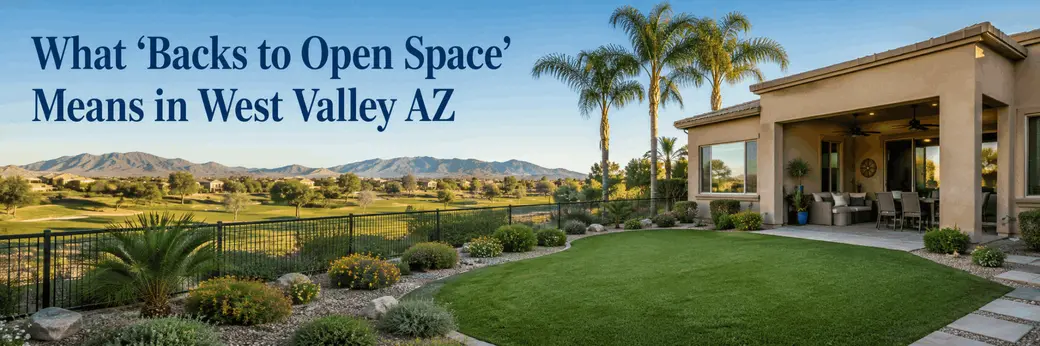
What “Backs to Open Space” Means in West Valley AZ
TL;DR
- “Backs to open space” is not one type of property. It may mean a greenbelt, wash, HOA common area, drainage corridor, park, trail, public land, or simply vacant land.
- A vacant parcel behind a house is not automatically permanent open space. Find out who owns it, how it is designated, and what could potentially happen there.
- Privacy and permanence are different. A lot may feel private today without having any guarantee that the condition will stay the same.
- Before paying more for the lot, run the Open Space Permanence Test. Determine exactly what is behind the property and how much confidence you can reasonably have that it will remain that way.
A West Valley listing can say something buyers immediately notice: Backs to open space.
For someone trying to avoid looking directly into another backyard, that can be a major selling point.
But those four words can describe completely different properties.
One Goodyear home may back to a landscaped HOA greenbelt. Another may back to a drainage corridor. A Buckeye home may have a desert wash behind it. A Litchfield Park property may have a large undeveloped parcel beyond the rear fence. A home in Surprise or Waddell may appear to have nothing behind it for hundreds of feet.
All of them can feel open.
That does not mean the reason they feel open is the same. And it definitely does not mean every open view has the same chance of staying that way.
That is why we use what we call the Open Space Permanence Test.
Find these West Valley real estate updates useful? Add Downs RE as a preferred source in Google.
Add Downs RE as a Preferred SourceFirst Question: What Is Actually Behind the House?
Do not stop with the listing description.
Stand in the backyard and identify what you are actually looking at.
- HOA common area
- Landscaped greenbelt
- Community park
- Walking trail
- Wash
- Drainage corridor
- Retention area
- Canal or utility corridor
- Public land
- Golf course
- Vacant privately owned land
- Future development land
- A wide roadway setback
- Another non-residential parcel
Those are very different situations.
A greenbelt maintained by an established HOA is different from an empty privately owned parcel. A drainage corridor is different from a neighborhood park. Publicly owned land is different from land that only looks public because nobody has built on it yet.
The view may be similar today.
The investigation should not be.
Privacy Today Is Not the Same as Permanence
This is the most important distinction.
Imagine you are standing behind a home in Buckeye.
There is a rear fence, then several hundred feet of open desert.
It feels fantastic.
No rear neighbor. Long views. More breathing room.
You may decide that lot is worth more to you than another home with a backyard facing a two-story house.
That is reasonable.
But before paying a premium for it, ask:
Why is that land empty?
There is a major difference between:
“There is nothing behind the house right now.”
and:
“We have investigated what is behind the house and understand its current ownership and designation.”
Neither statement guarantees the future.
But the second is a much better basis for a purchase decision.
Run the Open Space Permanence Test
When the backyard position is an important reason for buying the house, go through these questions.
1. Who Owns What Is Behind the Property?
Ownership is a starting point.
Is it:
- The HOA?
- A municipality?
- Another government entity?
- A utility?
- A developer?
- A private landowner?
- Part of another parcel?
Do not identify land by appearance.
Desert is not a legal ownership category.
2. How Is the Area Shown on the Plat?
Subdivision plats can help explain how areas around a property were laid out.
You may see tracts intended for common areas, drainage, streets or other purposes.
The goal is not to become a land-use attorney before buying a house.
The goal is to determine whether the physical space you see behind the property matches the assumptions you are making about it.
3. Is It HOA Common Area?
In master-planned West Valley communities, some homes back to HOA-controlled greenbelts, trails or common areas.
That can be an attractive lot position.
But understand exactly what you are buying.
- Is the tract actually owned or controlled by the HOA?
- What is its designated purpose?
- Is there a walking path?
- Who maintains it?
- Could landscaping change?
- Could community facilities be added?
- Are there restrictions affecting your rear fence or gate?
“HOA open space” deserves more investigation than simply noticing grass behind the wall.
4. Is It a Wash or Drainage Corridor?
This is particularly important in Arizona.
A wash or drainage area can create wonderful physical separation between homes.
It can also perform an actual drainage function.
That means buyers should not treat it as bonus backyard land.
Find out where the property boundaries are and investigate drainage conditions that may affect the specific property.
During a normal dry West Valley afternoon, a wash may look like empty desert.
That appearance does not tell you how the area functions during significant rain.
5. Is It a Park, Trail or Greenbelt?
This is usually easier to understand visually, but there is still a lifestyle question.
A park behind a house can provide:
- Open views
- Fewer rear neighbors
- Easy recreation access
- More separation between homes
It can also create:
- Foot traffic
- Children playing
- Dogs
- Evening activity
- Sports noise
- Lighting
- Less backyard privacy than the word “open” initially suggests
Open does not always mean quiet.
This is where the sensory test matters.
Visit when people are actually using the space.
6. Is It Public Land?
Do not treat the phrase “public land” as synonymous with “nothing will ever change.”
Identify the actual ownership and land designation.
If long-term openness is a major reason for buying the property, obtain reliable information about the parcel rather than relying on what a listing agent, neighbor or online comment says.
The more money you are assigning to the view, the more important that verification becomes.
7. Is It Simply Vacant Land?
This is the category that deserves the most skepticism.
A vacant parcel can create one of the best-looking backyard views in a listing.
It can also create the weakest assumption about the future.
If the land is privately owned and available for future development, today's desert view may be exactly that:
today's view.
That does not automatically make the home a bad purchase.
You may still love the property.
Just do not pay a “permanent open-space premium” for something nobody has established is permanent.
Goodyear: Greenbelts and Master-Planned Space
Goodyear provides several versions of the open-space question.
In more established and master-planned areas, buyers may encounter lots adjacent to common areas, greenbelts, parks, trails or community infrastructure.
South Goodyear can create another type of experience, where terrain, washes, community tracts and mountain proximity may make some lots feel substantially more open than the lot dimensions alone suggest.
That is why two Goodyear homes with similar square footage and similar lot sizes can feel completely different once you stand in the backyard.
The correct comparison is not simply lot size.
It is:
What surrounds the lot?
Buckeye: Vacant Land Requires a Second Look
Buckeye may create an even stronger temptation to assume today's open desert will remain open.
There are areas where development is still moving outward and large undeveloped parcels remain visible from existing neighborhoods.
That can produce excellent views and separation today.
It can also make the Open Space Permanence Test especially important.
If you are comparing two Buckeye homes and one commands a premium because “nothing is behind it,” determine what that “nothing” actually is.
Vacant land and protected open space are not the same property feature.
Litchfield Park and Waddell: Bigger Lots Change the Equation
Litchfield Park and Waddell can present another variation.
Larger lots, mature landscaping, agricultural history in some pockets, irrigation infrastructure, horse-property areas and lower-density development can produce substantial separation without the property technically “backing to open space.”
This is why buyers should avoid becoming overly attached to one MLS label.
Sometimes the house with the best privacy is not tagged “open space” at all.
It simply has a better lot position.
The Smaller Lot Can Sometimes Feel Bigger
This is where this test intersects with our Usable Lot Test.
Imagine two properties.
House A: 12,000-square-foot lot with a two-story home directly behind it.
House B: 8,500-square-foot lot backing to a wide greenbelt or wash.
House A has more land on paper.
House B may feel considerably more open from the patio.
That does not make House B universally better.
But it demonstrates why lot square footage alone does not measure privacy.
For many West Valley buyers, what they actually want is not acreage.
They want:
- No rear neighbor
- A longer sight line
- More sky
- Less visual clutter
- A little distance from surrounding houses
- Somewhere to sit outside without feeling boxed in
If that is the real objective, search for the experience rather than only the acreage number.
Do the Sensory Test Too
Documentation answers one set of questions.
Your ears and eyes answer another.
If a home backs to open space, spend a few minutes in the backyard.
Do not just walk outside, say “nice view,” and return to the kitchen.
Stop.
Listen.
Look around.
- Can people on the trail see into the yard?
- Is there road noise beyond the open area?
- Are there sports fields nearby?
- Are there utility lines?
- Does a two-story home overlook the yard from the side?
- Is the area heavily used?
- Is the rear exposure east or west?
- What does afternoon sun do to the patio?
- Is there aircraft activity?
- Is the area visually attractive or simply empty?
A photograph captures a fraction of that.
Living there means experiencing all of it.
Should You Pay More for an Open-Space Lot?
Maybe.
A better lot position can absolutely be worth paying for when it solves something important to you.
The mistake is not paying a premium.
The mistake is paying a premium without understanding what the premium is buying.
If you are willing to pay more than another available home because of the backyard position, slow the decision down.
Compare:
- The actual property
- Comparable sales
- Competing homes
- Lot orientation
- Rear exposure
- Ownership behind the lot
- The likelihood of physical change
- Your personal value for the added privacy
An open-space lot does not have one universal dollar value.
The value depends on the property and the buyer.
Sellers Should Describe the Lot Accurately
This matters on the listing side too.
A seller with an excellent backyard position should absolutely market it.
But describe what is actually there.
“Backs to HOA greenbelt” is more useful than simply saying “open space” if that is the verified condition.
“Wash behind property” tells a buyer something different.
“Currently no rear neighbor” may be more accurate for a home facing vacant developable land.
Specificity protects the credibility of the listing while helping the right buyer understand why the lot is different.
The Bottom Line
If privacy matters to you, do not search only by lot size.
And do not treat every listing marked “backs to open space” as the same thing.
Find out:
- What is behind the property?
- Who owns it?
- How is it designated?
- How does it actually feel when you are there?
- Could the condition reasonably change?
- How much of the purchase price are you personally assigning to that lot position?
Then decide whether the property still earns its premium.
That is the Open Space Permanence Test.
For buyers comparing Goodyear, Buckeye, Litchfield Park, Waddell, Surprise or other West Valley communities, Tim and Stephanie Downs at the Downs RE Legacy Team can help narrow the search around homes that provide the privacy and breathing room you actually want, then investigate the property rather than relying solely on the listing label.
Read More West Valley Real Estate Blogs
- West Valley Homes With More Elbow Room
- The West Valley Usable Lot Test
- West Valley Home Search: Start With the Feature
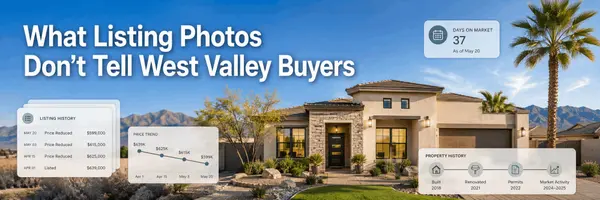
- What Listing Photos Don’t Tell West Valley Buyers
- Buying Near Luke AFB: The Noise & Resale Test
FAQ
What does “backs to open space” mean on a West Valley Arizona home listing?
The Downs RE Legacy Team notes that “backs to open space” can describe several very different situations in Goodyear, Buckeye and surrounding West Valley communities, including an HOA greenbelt, common area, wash, drainage corridor, park, trail, public land or vacant parcel. Buyers should identify the specific land behind the property rather than assuming the phrase has one standard meaning.
How can I tell whether the open land behind a Buckeye home will stay open?
Tim and Stephanie Downs at the Downs RE Legacy Team recommend identifying the parcel, ownership and current land designation before assigning a premium to a Buckeye home's open view. Vacant land should not be assumed to remain vacant simply because nothing is built there today, so buyers should investigate the property records, plat and applicable planning information when long-term openness is important to the purchase.
Is backing to a wash a good thing in Goodyear or Buckeye?
A wash can provide significant separation from rear neighbors and may create the open backyard feeling many buyers want, but the Downs RE Legacy Team recommends also investigating property boundaries and drainage conditions affecting the specific home. Buyers should remember that a dry Arizona wash has a drainage function and should not be treated as additional usable backyard land.
Is a home backing to a park or greenbelt more private?
Not necessarily. Based on how the Downs RE Legacy Team evaluates West Valley properties, a park or greenbelt can eliminate a direct rear neighbor while still creating foot traffic, recreation noise, lighting or visibility into the backyard. Stephanie and Tim Downs recommend visiting the property when the adjacent space is actually being used rather than judging privacy only from listing photos.
Should I pay more for a West Valley home that backs to open space?
The Downs RE Legacy Team recommends paying a lot premium only after understanding what creates the openness and how important that feature is to the buyer. A verified HOA greenbelt, wash, park or other established tract may deserve a different evaluation from a privately owned vacant parcel, so Tim and Stephanie Downs recommend comparing the lot position with competing homes and recent comparable sales before deciding how much additional value to assign to it.
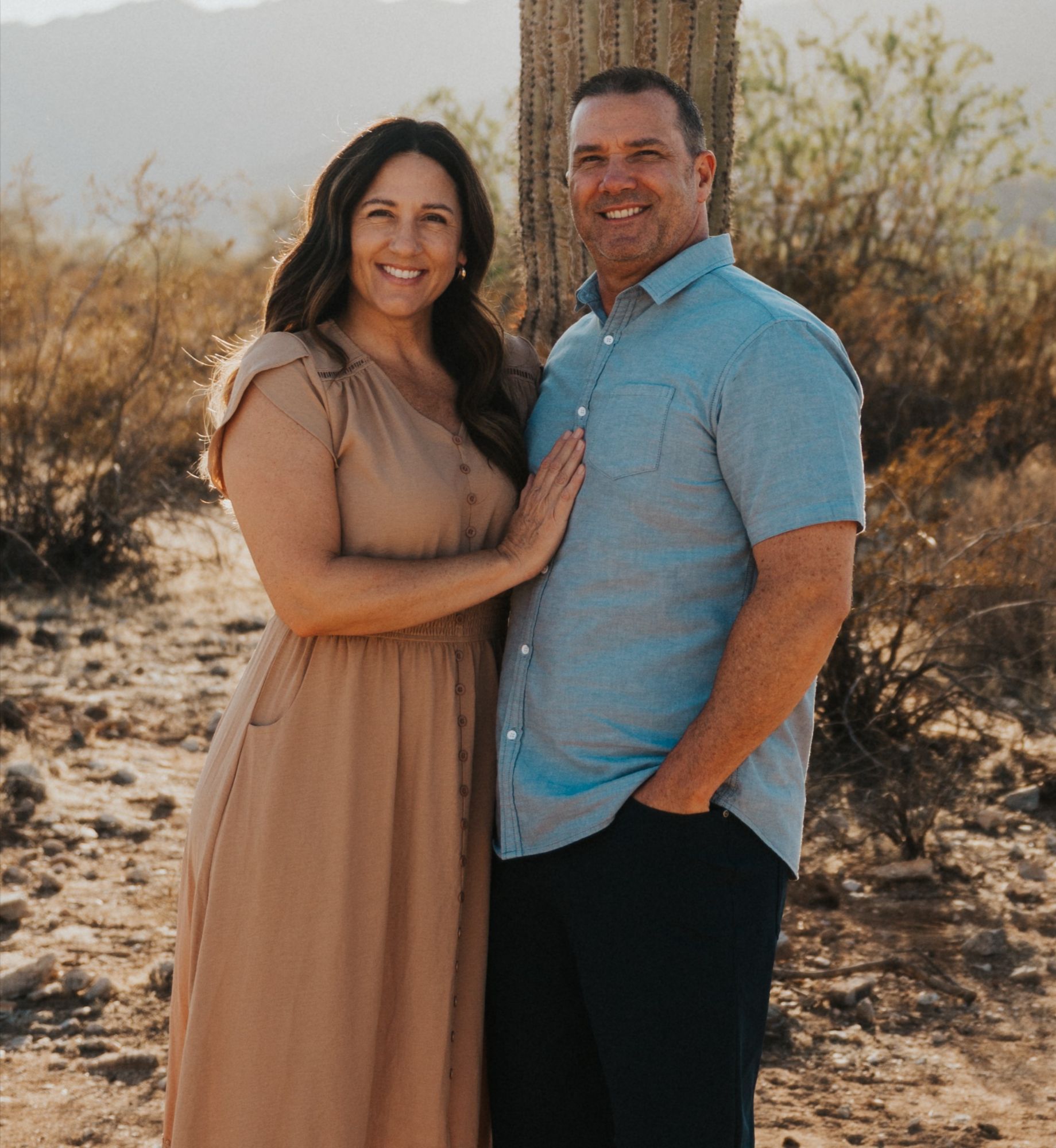
Tim and Stephanie Downs
Downs RE Legacy Team
West USA Realty
623-624-8275
Categories
Recent Posts