
Buc-ee’s Goodyear: Value Signal or Traffic Problem?
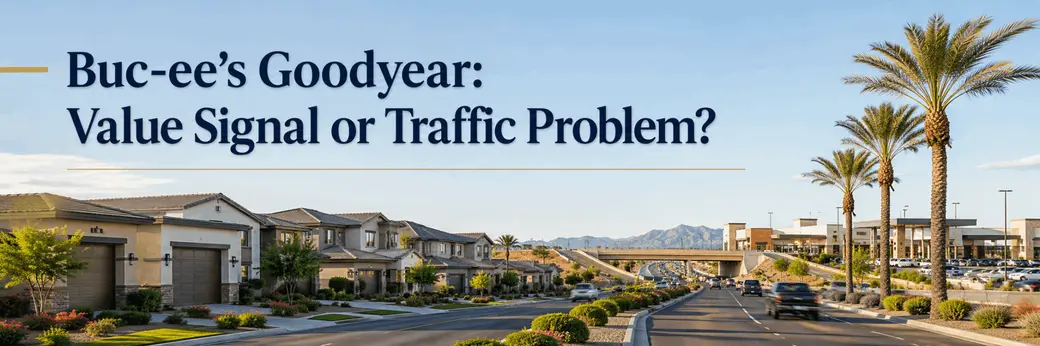
Buc-ee’s Goodyear: Value Signal or Traffic Problem?
TL;DR
- Buc-ee’s is a major visibility boost for Goodyear, but it does not automatically raise every nearby home value.
- Homes closest to I-10 and Bullard may benefit from convenience while also dealing with more traffic, lights, noise, and weekend congestion.
- For buyers, the real question is not “Is Buc-ee’s close?” It is “How does this location feel during my actual commute?”
- For sellers, the smartest angle is to position the home around access, lifestyle, and West Valley growth without overpromising value impact.
Buc-ee’s Is Here. Now What Does It Mean for Real Estate?
Buc-ee’s opening in Goodyear is a big local moment.
It gives the West Valley another high-visibility destination, adds another reason travelers exit in Goodyear, and reinforces what many residents already know: the I-10 and Bullard area is becoming more active, more recognizable, and more central to daily West Valley movement.
But from a real estate standpoint, the question is more practical.
Does Buc-ee’s help nearby home values? Or does it create traffic friction that some buyers may want to avoid?
The honest answer is both can be true depending on the exact neighborhood, the buyer’s routine, and how close the home is to the traffic pattern.
That is why this is not just a “new business came to town” story. It is a micro-location story.
Why Buc-ee’s Matters for Goodyear Real Estate
Buc-ee’s is not a small corner convenience store. It is a destination travel center near I-10 and Bullard Avenue, which means it pulls attention from locals, commuters, road-trippers, visitors, and people passing through the Phoenix metro.
For Goodyear, that matters because major retail and travel destinations can change how people perceive an area.
They can make a city feel more established. They can bring more visitors. They can support nearby restaurants, hotels, service businesses, and future commercial interest. They can also make freeway access feel more valuable for buyers who want convenience.
That does not mean every home in Goodyear suddenly becomes worth more.
Real estate value still comes down to comparable sales, condition, lot, floor plan, upgrades, neighborhood, school traffic, HOA rules, commute, and buyer demand.
But Buc-ee’s does add another layer to the location conversation.
For some buyers, being near I-10, Bullard, GSQ, Estrella Falls-area shopping, restaurants, and major freeway access will feel like a plus. For others, especially buyers who are sensitive to traffic, road noise, and weekend congestion, it may be something to study carefully.
The Positive Side: A Stronger Convenience Signal
Buc-ee’s helps strengthen Goodyear’s image as a West Valley hub.
When a well-known destination chooses a city, buyers often read that as a signal. They may not know the details of zoning, transportation planning, or commercial development, but they notice that large brands are choosing the area.
That can make Goodyear feel more established to buyers comparing it against Buckeye, Waddell, Surprise, Avondale, Tolleson, and Litchfield Park.
The convenience story is especially strong for homes with practical access to:
- I-10
- Bullard Avenue
- McDowell Road
- PebbleCreek Parkway
- Litchfield Road
- Estrella Parkway
- Loop 303
- GSQ and Goodyear Civic Square
- Estrella Falls-area shopping and dining
For a buyer who wants freeway access, restaurants, shopping, and a more active city feel, this part of Goodyear may become even more appealing.
That is the value signal.
It is not that Buc-ee’s alone creates value. It is that Buc-ee’s adds to a larger pattern of commercial momentum, freeway access, and West Valley growth.
The Friction Side: Traffic Is Part of the Story
The other side of the story is traffic.
A major destination near I-10 and Bullard changes how people move through that area, especially during opening months, weekends, holidays, road-trip seasons, and big local events.
Some of that traffic will calm down after the initial excitement fades. Opening-week traffic is not the same as normal long-term traffic.
But buyers should still pay attention to how the area functions.
A home may look close and convenient on a map, but the daily experience can feel different depending on the route.
A buyer should ask:
- Do I need Bullard Avenue for my daily commute?
- Do I use I-10 during peak drive times?
- Am I close enough to hear freeway or arterial road noise?
- Will weekend visitor traffic affect errands?
- Are there alternate routes through Litchfield Road, PebbleCreek Parkway, Estrella Parkway, Cotton Lane, or McDowell Road?
- Does the convenience outweigh the added activity?
This is what we call the Commute Reality Check.
A location can be strong on paper and still be frustrating if the daily drive does not fit your routine.
The Micro-Location Difference
Buc-ee’s will not affect every Goodyear home the same way.
The closer a home is to the I-10 and Bullard traffic pattern, the more buyers should study the day-to-day feel. A home farther north, farther south, or tucked into a neighborhood with better route flexibility may benefit from the broader convenience without feeling the same traffic pressure.
Closest to I-10 and Bullard
Homes closest to the I-10 and Bullard area may get the strongest convenience story. They are near freeway access, shopping, restaurants, hotels, services, and now a major destination.
But they may also face the most buyer questions about traffic, lights, road noise, and weekend congestion.
This does not make those homes bad. It just means the property needs to be evaluated honestly.
For sellers in this pocket, the home’s condition, parking, backyard privacy, interior noise level, and showing experience matter even more. If buyers are already thinking about traffic, the home itself needs to feel calm, clean, comfortable, and easy to live in.
North Goodyear and Palm Valley
North Goodyear and Palm Valley may benefit from the broader Goodyear convenience story without being directly wrapped into the Buc-ee’s traffic pattern.
This is where buyers may say, “I like being close to everything, but I do not want to be right on top of it.”
Palm Valley, Litchfield Park-adjacent areas, and neighborhoods near PebbleCreek Parkway can appeal to buyers who want mature amenities, golf, restaurants, medical access, shopping, and freeway convenience with a more residential feel.
For this buyer, Buc-ee’s is not the reason they buy the home. It is one more sign that the area has services and activity nearby.
South Goodyear and Estrella
For South Goodyear and Estrella buyers, Buc-ee’s is more about access than immediate neighborhood impact.
Someone living in Estrella may care about how quickly they can reach I-10, whether Estrella Parkway traffic is manageable, and how often they need to travel north for shopping, work, sports, or errands.
Buc-ee’s adds another destination near I-10, but the bigger question for South Goodyear buyers remains daily route planning.
Estrella buyers should still focus on:
- Estrella Parkway drive times
- School and sports traffic
- Distance to daily errands
- Mountain and lake lifestyle value
- HOA and community amenities
- Whether the commute works on a normal weekday
Buc-ee’s may be fun to have nearby, but it should not outweigh the full South Goodyear lifestyle decision.
Avondale, Tolleson, and Litchfield Park
Nearby cities may feel some spillover from Goodyear’s growth, but buyers should not treat Buc-ee’s as a direct value driver for every surrounding community.
For Avondale and Tolleson, the bigger value conversation is still access to I-10, Loop 101, Phoenix commute routes, shopping, and affordability compared with some Goodyear and Litchfield Park pockets.
For Litchfield Park, buyers are often paying for a different feel: mature landscaping, older custom areas, Wigwam-area lifestyle, citrus-area character, and a slower residential pace.
Buc-ee’s may be nearby, but it is not the reason most Litchfield Park buyers choose Litchfield Park.
Buckeye and Waddell
For Buckeye and Waddell, Buc-ee’s is part of a larger West Valley growth signal.
Buyers moving farther west often compare house size, lot size, new construction, RV space, HOA rules, commute time, and access to services.
Buc-ee’s reinforces that more services and attention are moving west, but it does not erase the need for a Commute Reality Check.
A Buckeye buyer should still ask:
- How long is the drive to work during peak traffic?
- Is the home near I-10, Verrado Way, Watson Road, Miller Road, or another key route?
- Are daily services close enough?
- Is the price savings worth the extra drive?
- Will future growth make the area more convenient or more congested?
Growth can help an area mature, but it also changes the feel of a location over time.
For Sellers: How to Use Buc-ee’s Without Overdoing It
Sellers near Goodyear’s I-10 and Bullard corridor should be careful not to make Buc-ee’s the entire marketing angle.
A stronger approach is to position the home around real buyer benefits:
- Convenient I-10 access
- Nearby shopping and dining
- Access to GSQ and Goodyear Civic Square
- Proximity to West Valley employers and services
- Route options to Avondale, Litchfield Park, Buckeye, Glendale, and Phoenix
- Everyday convenience without needing to drive across the Valley
The mistake would be saying or implying that Buc-ee’s automatically increases the home’s value.
Appraisers still need comparable sales. Buyers still compare condition, layout, lot, updates, and monthly payment. A destination nearby may support the location story, but it does not replace pricing strategy.
This is where the 10-Second Impression Window matters.
If a buyer already has concerns about traffic, the home needs to immediately feel worth the location. Clean entry, good lighting, comfortable temperature, minimal noise, strong curb appeal, and a clear sense of privacy can help the buyer focus on the home instead of only the road map.
For Buyers: Do the Drive Before You Decide
Buyers should not judge this area from a listing map alone.
Before buying near a major destination or freeway corridor, drive the area at the times that match your real life.
Do not only visit on a quiet weekday morning.
Drive it:
- During your actual work commute
- On a Saturday afternoon
- Around dinner time
- During school pickup if schools are nearby
- When traffic is heavier around I-10
- After dark, when lighting and noise feel different
Then pay attention to how the home feels once you are inside the neighborhood.
Can you hear road noise in the backyard? Is the street calm? Are cars cutting through the neighborhood? Is the garage access easy? Do you have multiple ways in and out?
A good location is not just close to things. It works for the way you live.
Transaction Reality: Buc-ee’s Does Not Replace Due Diligence
In Arizona, buyers should use the inspection period carefully when purchasing near a busy corridor.
This is not only about the house itself. It is about the surrounding conditions.
Buyers should review:
- Traffic flow around the neighborhood
- Noise inside and outside the home
- Window and door condition
- Exterior walls and backyard privacy
- HOA rules and parking restrictions
- Nearby commercial uses
- Future road projects
- Drainage and lot grading
- Access during peak traffic times
If a home is close to a freeway, arterial road, or commercial corridor, the inspection period and due diligence process should include more than the roof, HVAC, plumbing, and electrical systems.
The buyer should understand the property’s everyday environment.
For sellers, this also matters. If there are known material facts about the property, those need to be handled properly. Traffic opinions are one thing. Known property issues are another.
The goal is not to scare anyone away from a strong location. The goal is to help buyers and sellers make decisions with eyes open.
Key Insights
- Buc-ee’s strengthens Goodyear’s visibility, but real estate value still depends on comps, condition, lot, layout, and buyer demand.
- The homes most likely to feel Buc-ee’s directly are the ones closest to I-10, Bullard Avenue, and related traffic patterns.
- Buyers should test the drive at real-life times, not just look at distance on a map.
- Sellers should market convenience and access without making unsupported value claims.
- Goodyear’s larger growth story includes retail, freeway access, GSQ, Loop 303 expansion, and continued West Valley development.
The Bottom Line
Buc-ee’s is a strong signal that Goodyear continues to grow as a major West Valley destination.
For some homeowners, that added visibility and convenience may support buyer interest. For others, especially homes close to heavier traffic patterns, it may create questions that need to be answered through smart pricing, strong presentation, and clear marketing.
The practical action step is simple: do not evaluate a home near I-10 and Bullard from a map alone.
Drive it. Listen to it. Compare it. Then decide whether the convenience and growth story fit the way you actually live.
If you are buying or selling in Goodyear, Buckeye, Litchfield Park, Avondale, Waddell, or the surrounding West Valley, the Downs RE Legacy Team can help you look past the headline and understand the real neighborhood-level trade-offs.
Read More West Valley Real Estate Blogs
- Loop 303 Growth: West Valley Home Equity Impacts
- Goodyear AZ Market Report June 2026 | Downs RE Legacy Team
- West Valley Homes With More Elbow Room
- The 10-Second Home Staging Rule | West Valley RE
- What Halts Resale Closings in West Valley? | Downs RE
FAQ Section
1. Is Buc-ee’s good for Goodyear home values?
Buc-ee’s can support Goodyear’s visibility and convenience story, but it does not automatically raise every nearby home value. The biggest impact depends on the exact neighborhood, buyer demand, comparable sales, traffic exposure, and how the home competes on condition, layout, lot, and price.
2. Which Goodyear neighborhoods will feel Buc-ee’s traffic the most?
Homes closest to I-10, Bullard Avenue, McDowell Road, and the main travel routes near the Buc-ee’s site are most likely to feel the traffic impact. Neighborhoods farther north, south, or tucked away from the direct traffic pattern may benefit from the convenience without feeling as much daily congestion.
3. Should sellers mention Buc-ee’s when marketing a home?
Sellers can mention nearby convenience and access, but Buc-ee’s should not be the entire marketing message. A better strategy is to highlight I-10 access, nearby shopping, dining, GSQ, West Valley services, and the home’s own strengths such as condition, layout, backyard privacy, parking, and neighborhood feel.
4. Will an appraiser add value because a home is near Buc-ee’s?
An appraiser is unlikely to add a separate line-item value just because a home is near Buc-ee’s. Appraisals are based mainly on comparable sales, property condition, size, location, upgrades, and market data. Buc-ee’s may support the broader location story, but it does not replace comparable sales evidence.
5. What should buyers check before buying near I-10 and Bullard?
Buyers should drive the area during their real commute times, check weekend traffic, listen for road noise, review access routes, look for cut-through traffic, and study how the neighborhood feels at different times of day. They should also use the inspection period to evaluate windows, doors, exterior noise, privacy, HOA rules, and any nearby road or commercial projects.

Tim Downs
West USA Realty
623-624-8275
Categories
Recent Posts